The Iterative Process


A good deal of the success I've had is a direct consequence of my use of and belief in the "Iterative Process". Simply stated, it is a work methodology that relies on getting first impressions down right away, to form a foundation from which to work, and then applying oneself to constant and repetitive refinement to work out the bugs and arrive at a satisfying end result.
Most of the work I've done that is any good has found its way through this process. What's important to understand is that, by contrast, the iterative process eschews belaboring ones creative choices without relief till the problem is solved. It, in fact, relies on a constant process of detachment and re-engagement. The detachment is vital to success because it allows the mind a respite to recover as well as creates opens space to allow new and previously unknown influences to appear and affect ones view of the work.
By abandoning my work, I insure it's future success.
This probably seems counter-intuitive. Here's how I do it: I usually build or design a piece quickly and simply to just get the roughest outlines of it down while responding to early inspiration and intuitions. And then I step back. The rest is a process of repeated iteration and refinement that continuously improve and refine the work. I will I repeat this process ad-nauseam till think I’ve landed on something. This could also mean completely re-ordering the structure, which happens often and is an expected by-product of this process. And that can’t happen till I’ve tried to impose a structure in the first place. I start by working on instinct and then develop from there. It is a belief in the iterative process that actually assures finding ones voice in the piece.
So here is Mangini's maxim:
It is in the constant iteration and application to problem solving that the problem actually presents itself to be solved.
On Mad Max Fury Road, George Miller intuitively understood this idea and built it into our schedule. If you can believe it, we final mixed for 75 days! (when an industry standard is more like 10-12 days). We regularly revisited the sound edit and mix, each time making incremental improvements brought about through time away from the project as well as frequent collaboration and discussion. Our final mix found George Miller, Chris Jenkins, Gregg Rudloff, Tom Holkenborg and I huddled around the mix console working as a hive-mind. We would run a sequence and then debate its success by creating a safe place for all of us to voice an observation and enacting the best ideas in the moment. This happened endlessly. No idea was too small or insignificant because it might lead to a bigger observation.
We all respected the ephemeral nature of good ideas. No more so than George Miller himself. George would leave the mix studio and, during his ride home, find his mind inevitably starting to run through the work of the day as new ideas popped in his head. George would document these fleeting thoughts in voice dictations that he would send me that very evening to act on and explore the next day at the mix. Note that George never missed documenting his creative impulses before they had disappeared into the chaos of the thousands of other things on his mind.
My reliance and belief in the Iterative Process is informed by 45 years of doing it the other way and failing. That "other" way might simply be called the "beating a dead horse" method that most of us apply to our work. Avowed of the idea that quitting is bad, we illogically pursue the solution to a problem till we have exhausted all resources. How many time have you failed this way? How many times, after having exhausted all resources, did you have an epiphany, after the fact, for the solution but no means with which to effect it? This is the way most modern film mixes work. We have 12 days to final mix a film and we allocate 2 days per reel...and that's it. On to the next reel. And when we are done, we are done. No more time to fix, no time for reflection or distance or detachment. We have feverishly binged away our resources in a single run and left no time for contemplation that yields new ideas and solutions.
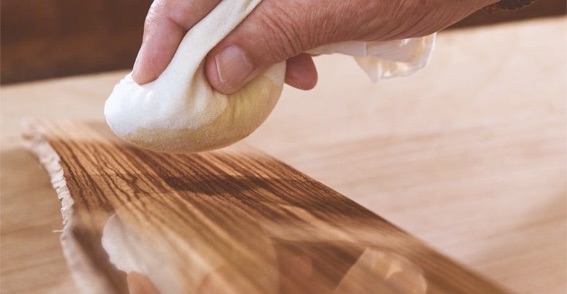
If you were wondering why I chose the image of the table and cloth as emblematic, it's because the process of French polishing a finish is a metaphor for the iterative process; it requires repeated applications of finer and finer polish to bring out the final lustrous shine of the finish. Each application of a finer grit of polish reveals greater detail in the wood and a more finished and beautiful end product.
Friday, January 1, 2021