The Vernacular

The Kuleshov (sound) Effect
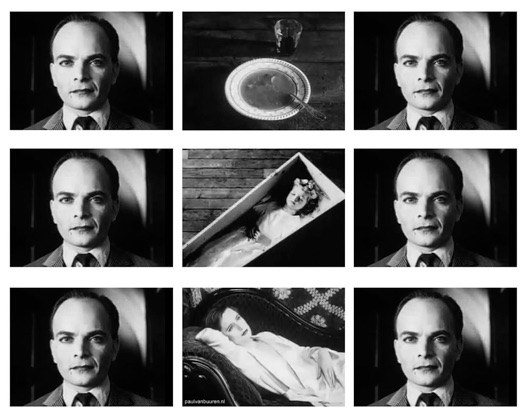
In the sequence, above (viewing left to right), the first frame contains a mans face. In the second frame we see food and in the third frame we see the same man's face. You may, as many audiences have, assumed that in the third frame the man looks "hungry". So too, in the second and third examples, does the man look "sad" (having seen a child in the coffin) and "lustful" seeing an attractive woman in repose. Yet the first and third frames are identical and, in fact are of a face arguably showing no emotion at all. How could this be?
In cinema this is called the Kuleshov effect. The Kuleshov effect is a mental (and Film Editing) phenomenon by which viewers derive more meaning from the interaction of two sequential shots than from a single shot in isolation. It leverages the inescapable need of the brain to create consequences for a collision of two disparate ideas (traditionally images) and find the fusion of the two somewhere that creates an internal logic.
Here's Hitchcock, with his interpretation of this powerful editing tool:
https://www.youtube.com/watch?v=96xx383lpiI
I think a similar effect occurs in the collision or juxtaposition of sound, especially non-diegetic) and image.
Sound is a very powerful narrative tool when leveraging this effect. Given that the brain is pattern seeking, the fusion or the juxtaposition of a sound with an image forces the audience to ask about relationship of these two pieces of information.
Imagine a script says, scene one, close-up of man’s face frowning. In the background we hear a baby crying. Don’t we assume automatically or wouldn’t we imagine the relationship between his look and the babies sound that maybe that man doesn’t like babies, maybe that man doesn’t like his wife. Maybe that man is dismissive of parenting or being a father. Simply by the juxtaposition of sound, we create an alliance of ideas. The beauty of sound is this malleability or suggestibility.
Sound can often be an economical storytelling tool in ways that writing cannot. Imagine you are on a close-up of a face. You don't know where you are but you hear the unmistakable "ding-ding" and you know your in a service station (in the 50's). How long would it take for that character to tell the audience (if it was even dramatically valuable) to explain it?
In some ways, the imposition of sound, untoward, on a scene accomplishes such an effect. The marriage of sound with image creates relationships the audience must reconcile. The more abstract the relationship, the more pressing the questions become about that relationship. Remember, the audience has "suspended disbelief". They are our captives and have ceded control of their psyches for the opportunity to be transported.
Experiment with the Kuleshov effect by applying sound to image in non-diegetic ways. Discover what impositions these collisions create and leverage those discoveries to the betterment of your storytelling.
Tuesday, February 19, 2019